Sunday, 22 January 2023

Skirts And its Types

 SKIRTS

Skirts is a type of fabric that surrounds the body from the waist down. While designing the skirts, the two most important factors to keep in mind are silhouettes & the length. Silhouettes refers to the shape of skirt which depends on the amount of ease in the garment.

The skirts are styled in four basic shapes:-

  • Straight
  • Pegged
  • Flared
  • Sheath Skirt
Classification of skirt on the basis of length:-
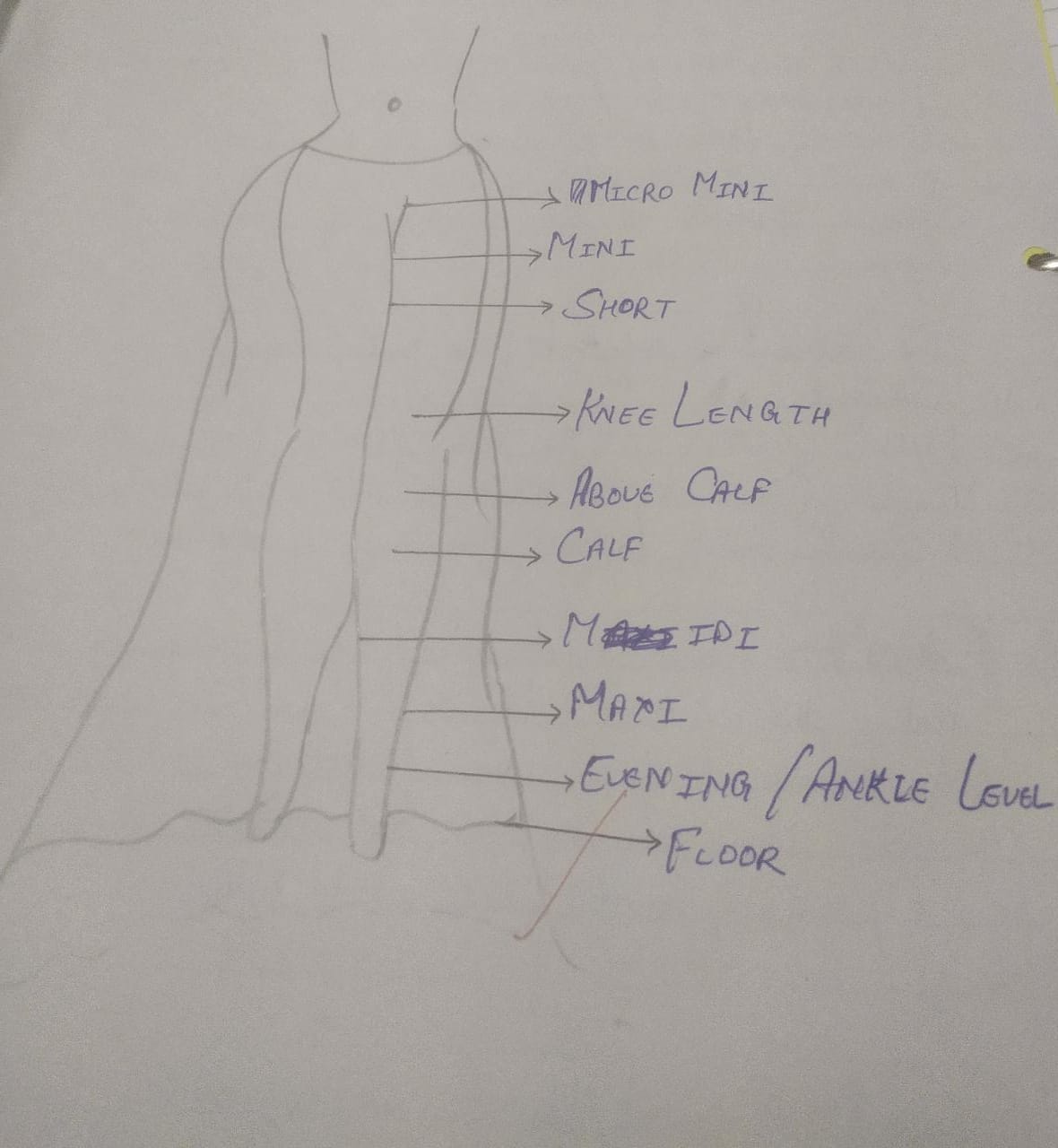


  1. Micromini Skirt:- A skirt which ends up to widest part of things is micromini skirt.
  2. Mini Skirt:- A skirt that is located some where between the widest part of thighs & above knees(short length skirt).
  3. Short Skirt:- The skirt hemline located between the widest part of thigh & above the knees.
  4. Knee Length Skirt:- A skirt the hemline of which ends up to knee level.
  5. Midi:- A skirt the hemline of which ends below the knee or ends to up to the calf.
  6. Maxi:- A skirt, the hemline of which ends around the widest part of lower length.
  7. Ankle Length Skirt:- A skirt, the hemline of which ends around the ankle bone.
  8. Floor Length:- A skirt that touches the floor length.
Types Of Skirts


  1. Gathered Skirts:- It's the simplest kind of skirt to make and consequently is often a beginner's first sewing project. The stiff fabric accentuates the hips and hangs away from the body. A soft fabric elings to the body and creates a more natural silhouette.
  2. A Line Skirts:-Skirts in the shape of alphabet' A'. It is narrow at the waist with/without darts and a little wide at the bottom used in casual garments to executive.
  3. Straight Skirts:- The side seams of straight skirt are aligned with the straight grain of the fabric and the cross-grain runs across the hips from side seam to side seam. The drop (difference between the size of the hip and the waist ) is removed with darts or gathers.
  4. Circular Skirts:- (Half/Full) This skirt can be half circular, or fall circular, or for the most exaggerated look, several full circles seam together of all skirts, this one is the widest at the hemline. It has a small waist, and the skirts pattern looks like a doughnut. It also wastes a great deal of fabric and is difficult to hem because it mostly on the bias. When a very full skirt is desired, especially for evening wear, several circular shapes can be put together for a dramatic effect. Half circular shirt is the most wearable version of this silhouette. It has a modified and graceful flare that is more easily cut from fabric of average width, fall out (waste fabric) is still a consideration.
  5. Flared Skirts:- A flared skirt is wider at the hem than at the waist.
  6. Gored Skirts:- A Gored skirt often has a centre back seam (with a zipper opening) that divides the back into two gores. A gored skirt is named by counting the number of gores. It does not have to be divided equally in front and back.
  7. Pencil Skirts:- This is similar to striped skirt but narrow at hemline with back slit opened more comfortably.
  8. Pegged:- A Pegged skirt is wider at the waist line and the excess fabric is gathered or draped into a wrist band. The side seams are tapered at the hemline. Variations include the surround tie, asymmetrical drape and nobble skirt. 
  9. Wrap Around Skirts:- A skirt fitted at waist and possesses a wrapped opening used is casual and executive wear.
  10. Pleated Skirts:- Generally pleated skirts are straight pieces of heat sensitive fabric that are pleated commercially fabrics made from fibre that do not down pose under height heat such as polyester, acrylic or blends of these fibres are best for pleating both knit and woven fabrics can be pleated.
  11. Tulips Skirts:- A Skirt having an overlapping of curve style lines in front like a tulip.
  12. Petal Skirts:-A skirt having more than two overlapping of curve style lines in front which give an effect of petals.
  13. Godet Skirts :- A skirt in which triangular pieces of fabric are sewn by cutting in hemline up to a depth get more flare at hem. used in lehengas and western bridal wear.
  14. Tiered Skirts:- A skirt with tiers pieces of uniform or non-uniform lengths stitched with each other at edges. The tiers vary in width, narrow from top and wide at bottom. used in skirts for teenagers.
  15. Layered Skirts:- A skirt with layers of fabric sewn at waist. These layers vary in lengths with or without gathers.
  16. Sarong Skirts:- A rectangular fabric is tied around waist in a knot to\ form shirt. The sarong and other asymmetrically draped skirts were popular during the late 1940's. They were worn for street wear as well as evening wear . The wrap sarong over a bathing suit has become a classic.
  17. Handkerchief:- A skirt which is cut in the centre of the square so as to stitch around waist with corners hanging at hem. used in a beach wear and is in fashion these days.
  18. Yoked Skirts:-A Yoke is a horizontal division in a garment. A skirt yoke can eliminate darts and gores by fitting the fabric over the hips and forming the foundation for the flared or pleated portion of the skirt. This is an effective way to make a skirt fir smoothly under a long top. The yoke should end 2 inches above the hem of the top so that the yoke seam is not visible.
  19. Flounce Skirts :- It is cut in two section, the upper one straight fitted and the lower one flounce. It is used in evening dresses.
  20. Balloon Skirts:- A skirt with hemline on fold turned up till waist. The fullness is achieved by stitching double turned up fabric layer also with upper fabric layer. The hem is like a balloon used in kids wear.
   21.Peplum Skirts:- A peplum is kind of short skirt cut as a flounce or flared tier, sewn on to the waist line of bodice or skirt.


Cuffs And Its Types

CUFFS

  • A Cuff is a band at the bottom of sleeves.
  • It may be part of sleeves turned back on itself or a separate piece attached to the sleeve.
  • It must be wide enough or have an opening at the bottom to allow a hand to pass through it.
  • Another element that matters when it comes to the varies outfits is the type of cuffs used.
  • It is non-essential part of any sleeve but mandatory in formal wear.
  • Clothing supporting cuffs with lace were first seen between the 15th and 18th centuries.
  • It is an additional piece of fabric sew at the end of sleeves.
  • It serves as an enclosure to the wrists ,and it comes in various styles.
  • Cuffs began to indicate the formality level of the shirt.
  • It is deemed that cuffs with links are the most formal in the fashion world, while those with buttons are the least formal.
How to customized Attire with types of cuffs:-

  • There are different ways to customize the style of different types of cuffs you are wearing while you can find different types of cuffs readily available at stores, you will need to have them custom made most of the time.
Shape:-When it comes to shapes, the most common among the cuffs are mitered, rounded, square, Among the three the most subtle and most common are round cuffs.
  • The square type is less common but looks good in casual attire.
  • Mitered type of cuff are seen as the most formal and elegant among these.
  • The corner of the mitered cuffs are angle at 45' and looks stylish.
  • On the other hand straight cuffs or square cuffs have angled corners.
  • Rounded cuffs have rounded top corners.
Collars:-You can find out of contrasting collars or with same monochrome collars for a long time white cuffs and collars have been used in non-while shirts.

Cuffs are classified in three categorized:-
Cuffs
  1. Casual:- Straight with size zip.
  • Elasticated divided.
     2.Elegant:- Edge with frill.
  • With puff links.
  • With fringes.
     3. Stitched:- Stitched with cuffs.
  • Stitched turned gap.
Types of Cuffs
  1. French/Double back cuffs
  2. British/Button/Barrel cuffs
  3. Cocktail cuffs
  4. Convertible cuffs
  5. Single cuffs
  6. Men's tailored cuffs
  7. Long Fitted cuffs
  8. Band cuffs
  9. Ruffles cuffs
1.French/Double back cuffs:- It is also known as classic cuffs.
  • This dressy cuffs style is popular in England.
  • Its name comes from the fact that it doubles back over itself.
  • These cuffs need cufflinks to close them at the wrist.
  • These have button hole on both side of cuffs for cufflinks.
  • Used by noble peoples.
  • A black tie event is among the rare occasions when this kind of cuff is obligatory.
  • Generally, has no pasting in cuffs.
  • The cuff style will add classiness and personality.
  • It is a norm to wear French cuffs with your business suit every working day.

2.Barrel:- This style is considered the most common types of cuffs and they are common on casual wear and business attire.

  • They are typically done with two horizontally placed buttons with 3/4 inch space in between.
  • Somewhere the buttons are placed vertically, but only seen this style in custom-made or fashion forward shirts.
  • King George has started it, it does not have cuff links instead buttons are used.
  • Initially started by noble people but later wear by general pubic too.
3.Cocktail:-It's a traditional style of cuffs.
  • This cuff style goes by many names-Turn back cuff, James Bond cuff, The Portofino cuff, and The Casino cuff.
  • The Cocktail cuff is a barrel cuff with a double-length cuff folded over until the hems form a diagonal line.
  • It is just double in length than other cuffs which are folded upward.
  • Especially got popularized after James Bond movie "Dr. No".
  • It has since then adopted by specialists as one of the most well-regarded fashion styles.
4.Convertible Cuff:- Convertible types of cuffs are not common, and you will only find them as an option in shops that after custom-made clothing.
  • More often than not, they are a double cuff, but some brands make them similar to barrel to barrel. Cuffs with an added hole between the buttons.
  • Convertible types of cuffs.
  • Convertible cuffs are quickly rising in popularity due to their versatility. wearers can trick the button to hide it internally , making room for the addition of a cufflink.
  • This is particularly suitable for people who want to wear cufflinks for a formal occasion yet fasten the buttons in all other circumstances.
5.Single Cuff:- This Cuff looks like a barrel cuff but fattens differently.
  • Single cuffs can be closed using a cufflink.
  • It is rare to find them off the rack since they are rarely used.
  • They only look good and neat  on wing collar shirts used in a white tie ensemble.
6.Men's Tailored Cuffs:- For a slightly larger and more interesting casual cuff consider the soft square two button.
  • The unfused cuff bands and conforms to the wrist much easier and generally have box pleat or knife pleat, gathers at centre.
  • These have 2 buttons.
7.Long Fitted Cuffs:-As the name suggest these fitted cuffs of general length vary from 3"-6".
  • These are directly attached to sleeves with 2-3 gather , have no placket attached.
8.Band Cuffs:- For long puff sleeve.
  • Used to finish the edge of sleeve, the cuff is used as band.
  • The width of these cuff are 1.5 and 2".
9.Ruffle Cuffs:- Typically used in girls wear.
  • The fabric used in these cuffs are shimmer thin & light weight fabric.
  • No hemming is done at the end of these cuffs only Pico is done.

Yokes And Its Types

         YOKES 

  • Yokes is the frame of the fabric that placed around the neck.
  • Yokes are used for fitting and decoration of any garment.
  • yokes affer a great opportunities for design variation.
  • It is extra fabric used for designing in garment.
  • It is attached on opening part of garment, and can be of same and different fabric.
  • Yoke can be seen on upper and lower torso garments, at neck waist.
  • It is based on geometric shapes.
  • Tucks, pleats, gathers, embroidery prints, laces and anything can be attached on yokes.
  • To give extra bounce and fitting to garment yoke is added.
  • We need to be carefully selects the shape of yoke as it can destroy the over all look of any garment.
  • It is functional like on gent's shirts, nighty,small bodice block and can be decorative like on top, kurti,skirts.
  • It's the part of a garment that can be decorative or structural.
  • Decorative yoke ensure that the structure of the clothing is emphasized.
  • Yokes are separate part of a garment.
  • Variations in garments can be created using yokes.
  • Proper placements of yoke is very important.
  • Yokes are of two types,namely yokes without fullness(basic yokes)and yokes with fullness(decorative yokes).
  • Yokes can be introduce in a garment to release fullness and for ease of movement.
  • It is used for supporting loose parts of the clothing. Wide yokes provide a low slung look on pants.
  • A yoke is a shaped pattern piece that forms part of a garment.

TYPES OF YOKES

There are two types of yokes:-

Basic Yoke:- From the name itself the basic yoke is a simple or plain yoke that you cut and join according to the garment's structure.

  • This yoke is a part of the garment which is cut and joined with a piping or seam, typically seen on the front and back of men's shirt.

Decorative yoke:- The decorative yoke adds visual interest to the garment.so other than using a contrasting colour fabric for the yoke, the sewer can also add piping to its edges for additional styling.


  • Use of various tucks, pleats and frills add interest to the garment.
  • Yokes of desired shape can be cut and stitched.

YOKES BASED ON THEIR SHAPES


      1.Straigt Yokes:- This Yoke is generally used in shirts and night dresses.

  • This yokes is straight at the bottom and yoke length is approx...armhole depth,
  • It may be increasing or reduced.
  • To individual,straight yokes will ensure that the parts will full straight perfectly.

       2.Round Yokes:-This yoke is used for night wear like night suits, gowns and also in                                          baby frocks and    tops.

  •   It can also use in any type of embroidery, smoking.
  • This yoke shape is round and the preferable neck with this yokes round.
  • Upwards are yokes give shape to the garment to enhance the rear part of women's clothing.

      3. Square yokes:-This yoke is square in shape .

  • This yoke is used in low waist line dress,night dress and kids wears.
  • This yoke length is approx...14'',15'' ace.

    4. V-Shape yoke:- V-Shape yoke is generally use in low waist line dress.

  • The yoke shape is ''V'' and the preferable neck line is round and V-Shaped yokes and curves to the features of the jeans that you seat on, while inverted yokes ensure a fuller seat since the middle part of it is higher than the seams outside.

   5.Glass Shape yoke:-It is used in baby dress, night dress and suits.

  • It may be decorative with embroidery and laces.

  6.Saddle yokes:- It is decorative yoke in shape saddle(matka) used in stylish garments.

  • It is waist level yoke with many cuts and curves.


Thursday, 17 March 2022

  Characteristics of Computers


1. Speed
2. Accuracy
3. Storage
4. Automation
5.Versatility
6.
Reliability
7. Security
8. Diligence
9. Multitasking
10.Sharing 

1.Speed:- Computer can complete any task & any kinds of Calculations within a few seconds, because computer is a super fast machine.

2. Accuracy:- Computer is very accurate about its result, each calculation performed by computer is 100%. correct.

3. Storage:- Computer have high storage capacity, due to which they can store large amount of data.

4. Automation:- Computers are automatic machine because once started on a job, they carry out the job until it is finished.

5. Versatility:- Computer is a versatile device because it can perform a variety of task. We can do work any type in computer.

6. Reliability:- Computer is a reliable machine that can be trusted for a long time. This is the reason that's today every organization depend on the computer for their work. It can't be share any Information without our permission.

7. Security:- Security is the biggest feature of computer it provides us high security. It is the form of (password, hide and encript).

8. Diligence:- Computer is a machine, that can do any work 24x7 without being tired, non stop & Without any fault.

9. Multitasking:- Multitasking is one of the greatest  features of  Computer because they can do many tasks at same time. (We can   sing a song, make a file etc.)

10.Sharing:- In computers, it is possible that we can easily Share our data or information from one computer to another. 


Wednesday, 2 February 2022

My Inspiration


🍀कविता🍀

खुद ही खुद की पहचान लिखूँगी ।
कठिन रास्तों पें चलकर नयी दास्ताँ लिखूँगी,
अकेली चलुँगी मगर कारवा लिखूँगी, 
पैर जमीन पर होंगे लेकिन सपनों में आसमाँ लिखूँगी,
खुद ही खुद की पहचान लिखूँगी
ना सपनों की तस्वीर बदलूँगी,
ना चलने का तेवर बदलूँगी,
घेरे चाहे प्रलय की घनघोर घटाएँ,
रास्तों से ही मंजिल का पता पूछूँगी,
अपनी राह खुद बनाऊँगी,
खु ही खुद की पहचान लिखूँगी
बुरे वक्त का चेहरा बेनकाब करूँगी ।
अच्छे वक्त का खुद आइना बन जाऊँगी,
भाग्य की रेखाओं को कर्म से बनाऊँगी,
किस्मत का सितारा खुद की बन जाऊँगी,
खुद ही खुद की पहचान लिखूँगी 


Thursday, 6 January 2022


What is Fashion?

Fashion is a way of introducing yourself without having to say a word. You can tell the whole world about your personality just by the type of clothes you wear. It is also a way to express yourself. It provides us with a creative outlet that we can constantly change and improve.

[Fashion is our imagination to think a new and unique things. Fashion is not only our dress up its our makeup, hair style, and how can I talk to other peoples and our way of thinking to express our feelings. It is a way of  positive thinking in our life.]

 Classification of Fashion:

For knowing fashion elaborately learning about classification is very important. A fashion expert knows fashion apparel as a unique product, one that reflects self-concept, life-style, change, time and place.

Fashion is classified into many types, such as:

1.      Style

2.     Basic or classic

3.     Fad

4.     Fashion Forecasting

5.     Trends


1. Style:
Style is always constant. It is not changeable like to fashion. It is the modification of fashion. Style is the basic outline of any garment. It is a manner of doing something. It commonly refers to one’s fashion or outer appearance. Style word is very popular in fashion. Style is unique but when it is accepted by others then it is called fashion.

2. Basic or Classic:
When a fashion is comparatively constant or long lasting or continuing for many days, such as saree and salwar kameez, it is called Basic or Classic. The saree and 
salwar kameez are part of fashion scenery. A customer has one or more in his wardrobe, to be worn to suit different occasions. In certain times, the basic becomes the most important promotable fashion, but, in or out, they remain as a part of the fashion scene.

3. Fad:
Fad is a more uncertainable  word for a fashion designer. Because it can either makes a designer’s life more interesting or tenser. Sometimes something appears on the fashion scene that captures the imagination, only to fizzle out in short duration.

After all, fad can be denoted as a short lived fashion, staying for a very little duration of period or time, acceptable by only a certain group of people. In maximum time they are very costly and every one cannot afford to buy it.

4. Fashion Forecasting:
Fashion forecasting is the prediction of mood, behavior and buying habits of the consumer that focuses on upcoming trends. It is very important part of fashion scene because when a new garment is designed by a designer and worn, it will not create fashion by itself. It needs to spread fashion with different media. Fashion forecasting is commonly done by many communicating media, such as, fashion shows, cinema, newspapers, press, fashion magazines and window display.

Generally, fashion forecasting includes:

a.      Consumer research

·         Surveys

·         In-store informal interviews

·         Consumer focus groups

b.     Market research

c.      Fashion trends

d.     Shopping

e.      Evaluating the collections

f.       Sales records

g.      Trend for target markets

5. Fashion Trends:
Fashion trend is the most changeable term in fashion. It is the styling ideas that major collections have in common. Fashion trends are influenced by several factors which include economical, political, social and technological. Fashion forecasters can use this information to help determine growth or decline of a particular trend. Sometimes a new trend appears in small doses until it spreads to other collections. As the mass media notices similarities between collections and highlights them, the media exposure also helps establish the trends. But if the market becomes flooded with a new trend, consumers may react negatively to the overexposure.

Fashion Design

Fashion design is the art of creating clothing and accessories. ... As an art practice, fashion design is intertwined with culture. Fashion designers create garments based on consumer demand or their own creative vision, and consumers respond to those designs, ushering in new trends.


Fashion Technology

Fashion Technology as a field emphasizes on the techniques and equipment used to produce fashion products. Thus, Fashion Technology involves the use of various techniques and equipment for the production as well as management of fashion goods that are produced


How to keep in touch with latest fashion:-

  1. Watch Fashion Shows. Fashion shows are where trends start. 
  2. Check out Celebrity Style. 
  3. Read Fashion Magazines. 
  4. Find a Blog You Like. 
  5. Take Inspiration From Around You. 
  6. Follow Professional Stylists. 
  7. Have Basics That Are Always in Style. 
  8. Don't Fear Changing up Your Style.

 How can I choose a fashion style for myself?

How to Find Your Personal Style in 5 Steps

  1. Look to your own closet. Think about the clothes you have that make you happy.
  2. Find fashion inspiration. 
  3. Create a fashion mood board. 
  4. Create a capsule wardrobe. 
  5. Experiment with unique style choices.

Fashion Industry

The fashion industry consists of four levels: the production of raw materials, principally fibres and textiles but also leather and fur; the production of fashion goods by designers, manufacturers, contractors, and others; retail sales; and various forms of advertising and promotion.

Fashion Industry And Its Scope

     Career Opportunities in Fashion Designing

  • Fashion Designer.
  • Retail Buyer.
  • Retail Manager.
  • Fashion Stylist.
  • Jewellery and Footwear Designer.
  • Personal Shopper.
  • Makeup Artist.
  • Fashion Model.
what is the importance of fashion in day to day life:-

1-  fashion is important in our daily lifeFashion is a constant presence in a       person's life.

       2- It is a daily task of choosing what clothing to put on our body.

         3-If you're into fashion, you'll understand why the Indian celebrates Fashion Week like.


Sleeves

Sleeves Sleeve is a Dutch word derived from word slip. It is a part of garments that proper the arms covers or grow passes a...